
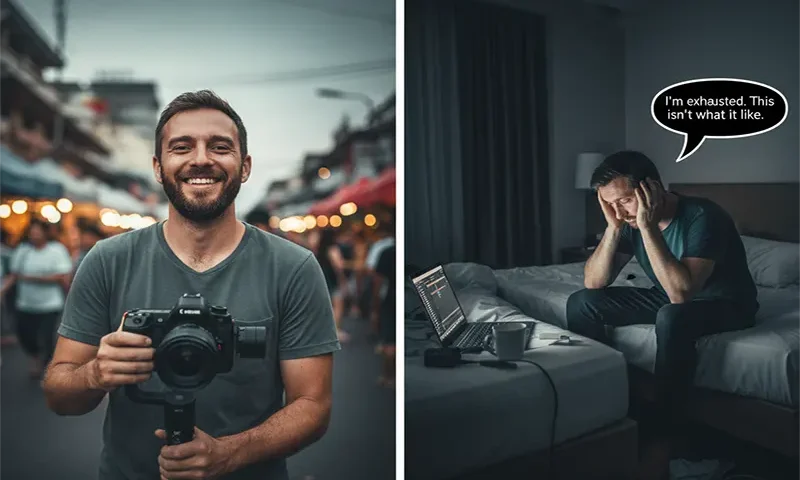
In 2026, the travel vlogging industry has reached its “Great Recalibration.” After a decade of the “hustle-and-wander” culture, the gold-leafed frame has cracked. We are seeing a surge of high-profile creators “going dark” or pivoting to “Slow-mading” as the psychological cost of living for the lens becomes too heavy to ignore.
1. The Performance Paradox: Smiling Through the Static
In 2026, the primary source of burnout isn’t the travel itself—it’s the “Performance Paradox.” This is the exhausting cognitive dissonance of projecting high-energy, “life-is-perfect” vibes while experiencing a panic attack or deep isolation behind the camera.
- The Hollow Sunset: One veteran solo vlogger recently shared, “I was standing on a cliff in Madeira with the most beautiful sunset I’d ever seen, and all I could think about was that my battery was at 4% and I hadn’t captured a wide shot yet. I wasn’t at the cliff; I was in a production meeting with myself.”
- The Mask: The emotional labor of “performing” joy for an audience when you are struggling with jet lag, food poisoning, or loneliness creates a unique form of trauma. By 2026, “Algorithm Anxiety”—the fear that one day of authentic rest will tank your reach—has become a clinically recognized stressor among creators.
2. The Isolation of the Longtail Boat
Solo vlogging is a “one-person crew” lifestyle that often leads to a specific type of social starvation. You are the director, talent, and editor. Your primary interactions are often through a screen, and your “friends” are data points in a comments section.
- Loneliness in a Crowd: There is a profound loneliness in being at a world-famous landmark and having no one to turn to and say, “Wow,” without a microphone attached to your lapel.
- Home Base Identity Crisis: In 2026, many vloggers are hitting a wall where they no longer know who they are without their “travel persona.” The lack of a physical home base leads to “rootlessness,” which researchers have linked to increased rates of chronic anxiety and depression in the nomad community.
3. The Digital Nomad Trap: “Wasting” Paradise
A unique 2026 phenomenon is the Guilt of Rest. For a travel vlogger, every hour not spent filming is seen as a “lost opportunity.”
- The Content Debt: As one creator put it, “If I spend a rainy Tuesday in my Airbnb watching Netflix instead of exploring a local temple, I feel like I’m stealing from my audience. I feel like I’m ‘wasting’ my life, even though my body is screaming for a nap.”
- Decision Fatigue: When every single choice—what to eat, where to sleep, which lens to use—is also a business decision, the brain enters a state of perpetual “Decision Fatigue.”
Vlogger’s Mental Health Red Flag Checklist
If you are a creator in 2026, these are the signals that your “dream” is becoming a nightmare:
- Irritability at Beauty: You feel annoyed when you see a beautiful view because it “requires” you to work.
- The “Viewfinder Filter”: You realize you haven’t looked at a landmark with your own eyes in weeks—only through a screen or monitor.
- Digital Dread: You feel a physical “sink” in your stomach when you receive a notification or see your “Watch Time” analytics.
- Identity Blur: You can’t remember the last time you did something without wondering if it would make a good story or Reel.
4. Reclaiming the Journey: The 2026 Recovery
The “Great Recalibration” has birthed a new movement: JOMO (The Joy of Missing Out). Creators are now leading the charge in radical acts of self-care.
- “Going Dark” Months: It is now common for major vloggers to take one month off every quarter—not just from posting, but from filming.
- Analogue Stays: A rising 2026 trend is the “No-Tech Trek,” where creators visit remote areas specifically because they have no Wi-Fi, forcing a separation between “life” and “work.”
- Base-Camping: Instead of “fast-traveling” through 10 countries a year, 2026 vloggers are “Slow-mading”—staying in one city for 3–6 months to build a routine, join a gym, and make “real-life” friends who don’t know their sub count.
Presence Over Plans
The most successful vloggers in 2026 are those who have realized that content is a byproduct of a life well-lived, not the goal of it. Your value as a human is not measured in CPM or engagement rates, but in the depth of the breaths you take when the camera is tucked away in your bag.

