
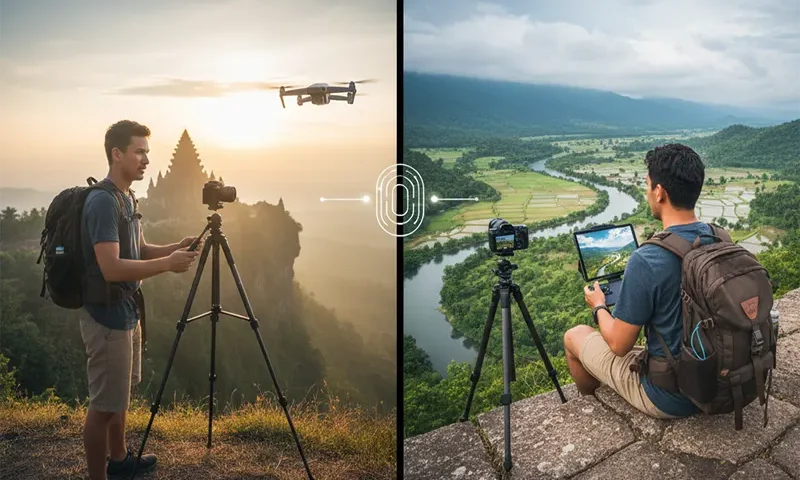
In 2026, the solo travel vlogger is no longer just a person with a camera—they are a director, cinematographer, and lead talent rolled into one. Thanks to significant leaps in AI-tracking hardware and autonomous drone flight, the “one-person crew” can now produce footage that previously required a production assistant.
1. The 2026 Solo Toolkit: Smart over Stuffed
The key to solo vlogging is reducing “friction.” In 2026, the best gear is that which thinks for you.
- The AI-Powered Tripod/Gimbal: Tools like the DJI Osmo Mobile 7P or the Hohem iSteady V3 Ultra have become essential. They feature built-in AI vision sensors that track your face 360° without needing a smartphone app to stay open. For mirrorless users, the DJI RS 4 Mini offers the same intelligence for heavier payloads.
- The Autonomous Drone: The DJI Mini 5 Pro (or the ultralight DJI Lito X1) is the 2026 gold standard. With its 1-inch sensor and forward-facing LiDAR for nighttime obstacle avoidance, you can fly safely in complex environments like forests or narrow alleys.
- The Audio Anchor: Soloists often forget audio. Systems like the DJI Mic 3 or Rode Wireless PRO now feature 32-bit float internal recording, meaning your audio will never “clip” or distort, even if you’re shouting at the wind on a cliffside.
2. Mastering the Tripod: Creating Motion Alone
Static shots are the fastest way to bore an audience. To make your solo vlog feel high-budget, you must simulate a cameraman’s movement.
The “Invisible” Pan
Set your AI-tracking tripod on a flat surface. Using Gesture Control (a standard 2026 feature—usually a palm or “V” sign), command the tripod to lock onto you. As you walk past the camera, the head will pan smoothly, following your movement. This creates a “follow shot” that feels dynamic and intentional.
The Stand-In Focus Hack
Even with 2026’s advanced Eye-AF, setting focus for a shot where you are 20 feet away can be tricky. Use your backpack or a water bottle as a “stand-in.” Focus on the object, lock it, then swap places with the object. This ensures you are tack-sharp before you even start talking.
3. The Drone: Your “Eye in the Sky” Cameraman
In 2026, manual drone flying is for B-roll; autonomous modes are for storytelling.
- ActiveTrack 360°: On drones like the Mini 5 Pro, you can select yourself on the screen and choose a “Spiral” or “Orbit” path. The drone will automatically maintain a cinematic distance while dodging trees using its LiDAR sensors.
- The “Reveal” Shot: Start the drone at eye level, facing you. Walk toward the horizon. Program the drone to fly backward and upward simultaneously. This classic “dronie” is the perfect way to show the scale of your location (e.g., the Scottish Highlands or a Thai island).
- Waypoints 2.0: Set a path for the drone to fly while you are driving or walking. In 2026, you can save these paths and repeat them at different times of day (e.g., golden hour vs. blue hour) for a seamless “time-lapse” transition.
4. Workflow: The “Run-and-Gun” Strategy
Filming alone is exhausting. To avoid burnout, follow the B-Roll First rule.
- Capture the Environment: When you arrive at a location, spend 15 minutes getting “anonymous” B-roll (feet walking, close-ups of flowers, wide landscapes).
- The Talking Head: Once you’ve “warmed up” the location, set up your tripod for your primary narration.
- The Drone Finale: Save the drone for last. It is the most “high-energy” part of filming and usually attracts the most attention from locals.
2026 Solo Vlogger’s Toolkit Checklist
| Gear Category | 2026 Recommended Model | Key Feature for Soloists |
| Main Camera | Sony ZV-E10 II or DJI Osmo Pocket 3 | Fast AI Auto-Focus & Flip Screen |
| Drone | DJI Mini 5 Pro | LiDAR Obstacle Avoidance (Night Safe) |
| AI Gimbal | DJI Osmo Mobile 7P | Native 360° Tracking (No App Required) |
| Audio | DJI Mic 3 | 32-bit Float & 20-hour Battery |
| Tripod | Falcam TreeRoot | Ultra-fast “One-Touch” Leg Deployment |
Drone Pre-Flight Checklist (Solo Edition)
- Check Local 2026 Regulations: Ensure you are not in a restricted “No-Fly Zone” (check the B4UFLY or DroneDesk app).
- Calibrate Compass: Especially important if you are near large metal structures or mountains.
- Set Home Point: Ensure the “Return to Home” altitude is higher than any nearby trees.
- Check Battery: Solo filming takes 2x longer than you think. Start with 100%.
The Freedom of the Lens
Filming alone is the ultimate creative challenge. Without a crew to consult, every shot is an expression of your specific vision. By letting 2026’s AI handle the “how” (tracking and stabilization), you are free to focus on the “why”—the story of your journey.

