
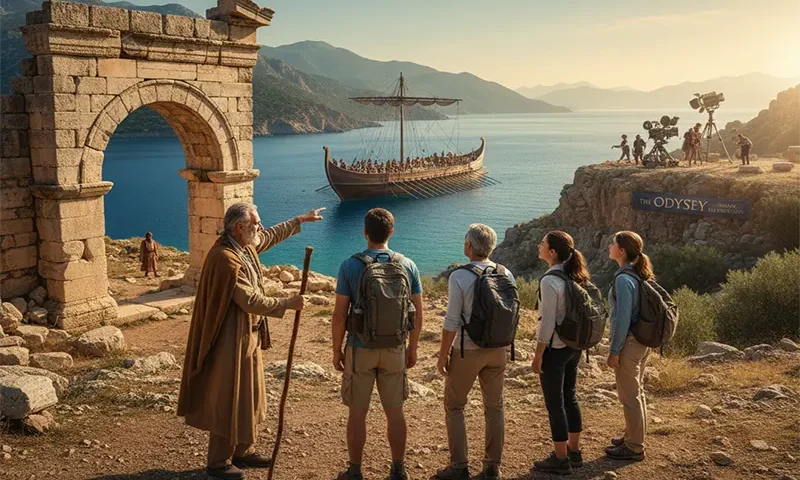
The scent of wild thyme and salty Mediterranean air has drifted over the Peloponnese for millennia, but in 2026, the region is experiencing a new kind of “epic” revival. Long considered the rugged, historical heart of Greece, this peninsula has become the centerpiece of a global “set-jetting” phenomenon.
From the 1997 classic miniseries to the 2024 film The Return starring Ralph Fiennes, and the massive 2026 Christopher Nolan production The Odyssey, the Peloponnese is no longer just an archaeological site—it is a living cinematic stage. For the traveler, this offers a unique opportunity: the chance to walk the line between the Bronze Age reality of King Odysseus and the sweeping, IMAX-scale visions of modern cinema.
1. The Mycenaean Stronghold: Where Kings Gathered
Any true “Odyssey” tour must begin at Mycenae, the UNESCO World Heritage site that Homer famously described as “rich in gold.” Historically, this was the seat of Agamemnon, the leader of the Greek forces and the man who summoned Odysseus to war.
Walking through the iconic Lion Gate, travelers find themselves in the very spot where cinematic history was captured. While the 1997 production used the massive “Cyclopean” walls to ground the story in grit and realism, the 2026 Nolan adaptation uses the Acrocorinth—a monolithic rock fortress overlooking the ancient city of Corinth—to depict the grandeur of a kingdom that once ruled the Aegean.
- The Historical Reality: Visit Grave Circle A to see where the famous “Mask of Agamemnon” was found.
- The Cinematic Magic: Stand atop the Acrocorinth at sunset to see the panoramic views of the Corinthian Gulf, a favorite shot for filmmakers looking to capture the “God’s eye view” of ancient Greece.
2. Pylos and the Kingdom of Nestor: Searching for a Father
In the Odyssey, Telemachus travels to Pylos to seek news of his father from the wise King Nestor. This coastal region of Messenia is perhaps the most frequent filming location for Odyssey adaptations due to its untouched beauty.
The Palace of Nestor at Pylos is the best-preserved Mycenaean palace in Greece. Recent 2026 tours now emphasize the “Griffin Warrior” tomb found nearby, which has upended our understanding of the period. However, for film fans, the draw is Voidokilia Beach. This horseshoe-shaped cove, with its turquoise waters and golden dunes, served as the primary backdrop for the 2026 film’s encounter with the Cyclops Polyphemus.
- Cinematic Highlight: Nestor’s Cave, perched on the cliff above Voidokilia, is used in modern cinema to represent the cavernous home of the one-eyed giant.
- Traveler’s Tip: Stay at the Costa Navarino, which served as the base for the cast and crew of The Odyssey (2026) and offers guided “Homeric hikes” through the olive groves.
3. The Wild Mani: Mythic Landscapes and the Underworld
As you drive further south into the Mani Peninsula, the landscape shifts from lush olive groves to jagged limestone and fortified tower houses. This is the “End of the World” aesthetic that directors use to depict the isolation of the mythic journey.
At the very tip of the peninsula lies Cape Matapan (Tainaron). In Greek mythology, this was the physical entrance to the Underworld—Hades. In cinematic adaptations, this rugged headland often represents the darker turns of Odysseus’s journey.
- The Site: Explore the ruins of the Temple of Poseidon, where ancient seafarers left offerings.
- The Legend: Brave travelers can hike to the sea cave at the base of the cliff—the legendary portal used by Orpheus and Heracles. Filmmakers often use the eerie, still waters of nearby Porto Kagio to represent the threshold of the spirit world.
4. The Logistics of a Cinematic Odyssey
Navigating the Peloponnese in 2026 requires a strategy worthy of Odysseus himself. To avoid the peak summer heat and the “set-jetting” crowds, the best times to visit are March–May or September–October.
| Location | Connection to The Odyssey | Modern Filming Use |
| Mycenae | Home of Agamemnon | Classical “Bronze Age” backdrops |
| Methoni Castle | Strategic Venetian Fort | Representing the “Return to Ithaca” (2024 film) |
| Voidokilia | Telemachus’s Landing | Cave of the Cyclops (2026 film) |
| Cape Matapan | Entrance to Hades | Supernatural & Underworld sequences |
Practical Advice for 2026:
- Car Rental: A 4×4 is recommended for reaching the more remote Mani locations used in filming.
- Nafplio as a Base: Use this elegant seaside town as your northern hub. It offers high-end boutique hotels and easy access to Mycenae and Epidaurus.
- The “Slow Travel” Approach: Don’t rush. The Peloponnese is best experienced at a “Homeric” pace—long lunches in seaside tavernas and late-afternoon swims in the Ionian Sea.
The Endurance of the Myth
Why do we continue to film The Odyssey in the Peloponnese, and why do we continue to travel there? It is because these limestone cliffs and ancient stones possess a “cinematic” quality that no CGI can replicate. Whether you are following the footsteps of Ralph Fiennes’s weathered Odysseus or the historical tracks of the Mycenaean kings, the Peloponnese remains the ultimate destination for those seeking a story that never truly ends.

