
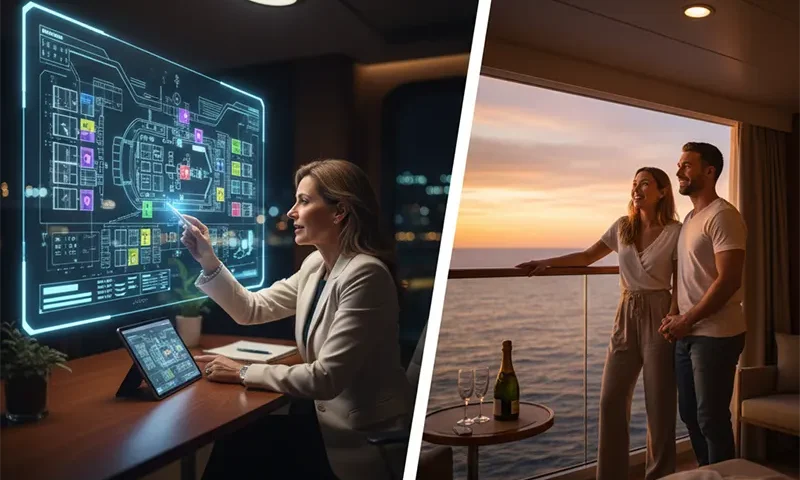
In 2026, the modern cruise ship is no longer just a boat; it is a 20-story floating metropolis. With the launch of behemoths like the Disney Adventure in Singapore, Royal Caribbean’s Star of the Seas, and the sophisticated Celebrity Xcel, the complexity of ship architecture has reached an all-time high.
While most travelers book based on price and a generic category—”Balcony” or “Oceanview”—the reality of your vacation experience is dictated by the specific coordinates of your stateroom. In this high-stakes environment, a specialized travel advisor acts as a “Deck Plan Architect,” using technical literacy to ensure your sanctuary doesn’t become a source of stress.
1. The Illusion of the Online Booking Tool
When you use a cruise line’s automated booking engine, the system’s primary goal is to fill the ship, not necessarily to find you the best room. Often, the “Guaranteed Cabin” categories—which offer a lower price in exchange for the line choosing your room—result in guests being assigned the “unsellable” inventory.
These are the rooms that a seasoned advisor knows to avoid. An advisor doesn’t just look at a list of available numbers; they look at the proximity, physics, and purpose of the cabin. They understand that a “Deluxe Verandah” is only deluxe if it isn’t vibrating from the engine thrusters or situated directly under the early-morning scraping of pool chairs.
2. Deck Plan Literacy: Decoding the “White Space”
To the untrained eye, a deck plan is a map of cabins and colorful public spaces. To a specialized advisor, the most important parts are the “White Spaces”—the unmarked, blank areas on a blueprint.
- Service Galleys and Pantries: White space between staterooms often hides service areas where crew members handle luggage, clink dishes, and prepare 24-hour room service.
- The “Sandwich Rule”: The gold standard of cabin selection is the “Sandwich Rule”—booking a room that has only residential staterooms directly above and below it. An advisor ensures you aren’t under the 24-hour buffet (clatter) or above the nightclub (bass).
- The Elevator Buffer: While proximity to elevators is convenient for those with mobility issues, being too close means enduring the constant “ding” of the arrival bell and the chatter of late-night crowds. An advisor finds the “sweet spot”: three to five rooms away from the bank.
3. Navigating the 2026 Fleet: Neighborhoods and New Categories
2026 has introduced revolutionary cabin concepts that require an expert’s nuance to navigate.
- Star of the Seas (Royal Caribbean): This Icon-class ship features “Neighborhood” cabins. A specialist can explain the trade-offs of a Surfside Family View Balcony. While great for watching your kids in the splash zones, it lacks the private ocean breeze and silence of a traditional hull-side balcony.
- Celebrity Xcel (Celebrity Cruises): The Infinite Verandah design on this Edge-series ship blurs the line between indoor and outdoor space. An advisor can help you decide if you prefer this tech-forward “power window” or if you are a traditionalist who needs a physical railing and a separate balcony door.
- Disney Adventure (Disney Cruise Line): With its massive 6,700-passenger capacity in Singapore, cabin placement is vital. A specialist knows which Garden View staterooms offer the best “stealth” views of the Garden Stage, allowing you to watch world-class shows from your own room.
4. Physics and Motion: The Pivot Point Strategy
For travelers prone to seasickness, deck plan literacy is a health requirement. 2026’s mega-ships use advanced stabilizers, but the laws of physics still apply.
A specialized advisor understands the “Pivot Point.” Just like a seesaw, the ends of the ship (Forward and Aft) move the most. An advisor will place sensitive travelers on a lower deck, mid-ship, where the center of gravity provides the most stable ride. Conversely, they know that while Aft-View Balconies (facing the wake) are the most romantic, they can be subject to “soot” from the funnel or significant vibration during port maneuvers.
5. The Stateroom “Red Flag” Checklist
Before you hit “book” on that 2026 sailing, see if your choice passes the advisor’s red-flag test:
- [ ] The “Lido” Check: Is there a pool, basketball court, or buffet directly above your head?
- [ ] The “Promenade” Check: Can people on the public walking track see directly into your “Infinite Verandah”?
- [ ] The “Obstructed View” Check: Does the fine print mention a lifeboat or a structural pillar blocking 50% of your view?
- [ ] The “Connecting Door” Check: If you aren’t traveling with the people next door, a connecting cabin has thinner soundproofing—avoid it.
6. The Advocacy Factor: Your Voice on Board
The value of an advisor extends beyond the booking. If you arrive in your cabin and find an unexpected issue—perhaps a noisy service door or a mechanical hum—your advisor is your advocate. Top-tier agencies have established relationships with Guest Relations Managers. A single call from your advisor can often facilitate a room move or a “surprise and delight” credit that a solo traveler would never be able to negotiate at the front desk.
Your Sanctuary in a Floating City
Your cabin is the only part of a 6,000-person ship that is truly yours. It is your sanctuary, your dressing room, and your quiet retreat. In 2026, the “best deal” is only a deal if you can actually sleep in it. Don’t leave your “home at sea” to an algorithm; use a deck plan architect to ensure your coordinates are perfect.

